What’s Next (for) Rad.io?

So, apart from a clever name, what will the Next Rad.io conference bring us?

Loads of “suits” talking the same old stuff that pours out of “industry” gatherings? Great ideas that are all well and good if you have huge budgets and unending resources? Or something else?

It’s designed for people who like radio, who want to be inspired by new ideas, who recognise that technology will help it to change and adapt and for those who want to meet like minded people.

I’m hugely looking forward to this conference. And I’m really glad that James Cridland and Matt Deegan are putting it on. This promises to be a great place for discussing new ideas, looking at things in a new way, and making new contacts. If I was starting out, this would be the place I’d be heading; loads of people who actually “do” radio thinking about how we can make radio better.

And there is a future for radio.

Sure, there’s lots of doom-laden statistics floating around about how younger listeners are failing to engage with radio. But not all of them. And only if radio refuses to engage with them, interact with them on the platforms that they hang out on, and actually deliver them the content they want to hear.

And radio still is radio. But it can be enhanced in many different ways. And let’s face it, whilst some people may sneer at the many ways that stations like Radio 1 and others have used to “visualise” radio, what they are doing now is really just a natural extension of what has been done in the past. From meeting listeners at the County show or the Radio 1 Roadshow at Great Yarmouth Beach, to the BBC radio Solent magazine that I remember buying as a child – they are all ways of extending the reach of the radio station.

But the biggest positive I have taken from the last few months is that fact that my daughter (8) has now decided that she wants to be on the radio and maybe run her own radio station.

This interest was started when she came to visit me at work way back when I was at Capital FM. She was 3 – and recorded 3 links which we made into a radio show for her to play in the car. She was also fascinated last time that Radio 1 did their Access All Areas week – as can be heard in this recording as she describes watching Newsbeat going out online.

Now, she has taken it one step further. Over the last few weeks, she has been recording her own radio show. She brainstormed what sort of features she wanted to run, what music she wanted to play (mostly the Capital playlist) and even how she wanted to broadcast (she wants to be on Red Button and can’t understand why it’s a bit complicated to make that happen).
Radio Victory Car Sticker

She’s now started to learn how to make a radio show – in basic form using Garage Band to drag in songs and record her links. She’s even recorded a report from her day out at Brands Hatch a few weeks ago. Now whilst this isn’t necessarily radio in its truest form, it’s no different from back when I was her age, where I recorded the ads and jingles off Radio Victory, and sat in my bedroom playing tunes off a battery powered record player, talking to no-one except my brother, and playing in ads from an old mono cassette recorder. The difference is, now, that I can record her and share a little of it with you.

So, it’s a bit rough around the edges. But she wrote the jingle, recorded the keyboard part, selected the samples and the instruments and the sound effects. And she loved it.

Maybe Next Radio or an event like it will inspire her in the future to do it for real. But only if we all help make it a reality for Megan and her Generation  – and keep making radio a medium that is relevant to them as well as us.

You can follow all things nextrad.io on Twitter @thisisnextradio and the conference hashtag is #nextradio  Radio Today are covering it live here. I’ll be there, doubtless tweeting interesting bits. If you’re coming, it’ll be nice to catch up – and if you’re not, hopefully you’ll learn something useful.

Bringing the Summertime Ball Alive

Image (c) Global Radio

Yesterday, Capital FM hosted its Summertime Ball at Wembley Stadium for 75,000 rain-soaked fans with acts ranging from JLS and Nicole Scherzinger to The Wanted and Jennifer Lopez.

I spent the weekend in Cardiff, once home to another similar event when Red Dragon FM was around. Cardiff is now one of the cities that has Capital FM as its own radio station. And this weekend in Cardiff it was all about the Ball. And even though the event was over 2 hours away in London – it still sort of felt local. All the local shows talked about was the fact that they had last-minute tickets to give away. All the news bulletins led with the Ball – with a reporter backstage and loads of quick relevant scene setting. And on Sunday morning when Cardiff was being soaked in a torrential downpour, the local host had upbeat, excited callers on, getting ready for “South Wales’ road trip to the Ball”.

In fact, the weekend served as a warm up for Take That’s arrival in Cardiff – an event that it seems is so anticipated that one local fashion advertiser has themed their local campaign around the band’s arrival.

My personal road trip home from Cardiff joined coverage of the Ball at about 4, and it was good to hear Capital throwing everything at it – from backstage reporters to “live” interviews along with (somewhat surprisingly) live tracks too. Live performances are hardly ever as good as recorded ones , so this felt a bit of a brave move for Capital. But as a passive listener, it made me feel part if the show. They were also making much of the HD photos available online along with video interviews. And I’m sure they will be hammering home the amount of online content (both photos and video) available for listeners to check out in the next few days.

Little is made of the backstage effort made to make this sort of thing happen. I know there will have been a fairly small team of hugely dedicated people working long hours to make this happen from engineers to online editors to producers. Maybe Global should shout publicly about this a little more – they should be proud of the team.

But, the moment I heard Capital FM’s Greg Burns link to someone high above London in the Flying Eye describing the sight of the stadium and the bands arriving, it felt like Capital had really nailed it. I’m uncertain whether the Flying Eye is still even in existence on air on Capital. But it is radio shorthand to Capital’s past that still exists in the collective memory (certainly for the older part of the audience). It’s a simple device to paint pictures and create context. And it was a nice subtle link to Capital’s past heritage too.

The Joy of 6 – new BBC 6 Music TV trail

This is the latest TV trail for BBC 6Music.  I particularly like the simplicity of the idea – all of the stations’ key talent actually building a radio station out of radios – and supporting the branding line of “building a digital home for music”.

TV ads/trails for radio stations are incredibly hard to get right.  Usually, it’s the simplest of ideas that work the best.

However, sometimes a simple idea doesn’t quite translate. Back when Capital FM rebranded first as Capital Radio and Capital 95.8, there was a TV ad that, whilst on paper looked great, in reality was a pretty hard watch. The idea was that Capital played music that made you want to nod along to it. The concept was great – that you’d see London from the viewpoint of someone listening to Capital on headphones  – but ultimately, was maybe asking just a little too much of the viewer.

Luckily, these days, Capital FM ads just do what they say on the tin – and BOOM – they work just fine!

Learn Radio (and TV) Production Skills for free from the BBC

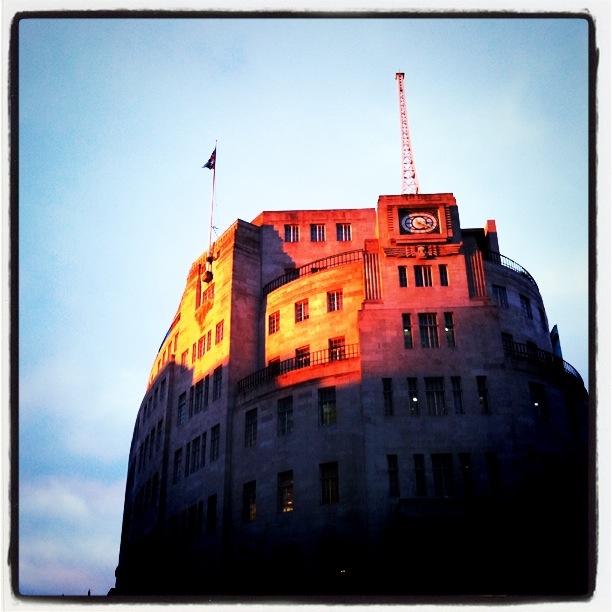
BBC Broadcasting House, Portland Place at the ...
Image via Wikipedia

The BBC College of Production website  has just launched.

 Now, anyone – not just BBC staff – can get a basic insight in the skills needed to make great TV, Radio or Online content. There are profiles of jobs, background “how to” films and details of talks and training courses.

In the radio section, there are details of music scheduling, setting up microphones, making a trail for Radio 2, and the role of a station sound producer.

For budding TV producers, you can learn about self-shooting, special effects, developing programme ideas, and how to shoot on green screen.

And if you need to know more about blogging, there’s a section on that too.

It’s a vast (and I guess constantly evolving) resource. See more at http://www.bbc.co.uk/academy/collegeofproduction/

Absolute Radio – Behind the sound

Absolute Radio logo
Image via absoluteradio.co.uk

This week at the Radio Academy Promotion and Marketing Awards, Absolute Radio picked up another haul of awards.

Along with the Creative Gold Award, they won Best National On-Air Promotion (with Faces for Radio), Best On-Air Sponsorship (for Baddiel and Skinner) and Best On-Air Imaging. This adds to the bronze award they picked up at this year’s Sony Radio Awards for Best Station Imaging.

A couple of weeks ago at the Broadcast Symposium 2010 in Nuremberg, I presented a session on Station Imaging in the UK, which featured a video with Absolute Radio’s Creative Director Vince Lynch.

Take a look now behind the thinking of what makes the sound of Absolute Radio.

You can hear more about this year’s awards on Steve Martin’s Earshot blog here.

Summertime Ball mixes it up

Image (C) Global Radio

Last year, I remember being fairly lukewarm to the coverage online and on air for Capital FM’s Summertime ball.

This year they turned up the heat.

Everything about this year’s show was bigger and better. But in particular, how they interacted with the audience in the build up to the day.

Twitter was alive with #stball tweets all day. In fact – at one stage the event was trending in Twitter’s Top 10.

Capital kept listeners up to date with everything backstage, featured loads of user generated pictures, and threw up loads of videos from the performances the next day.

And most impressively, used new technology such as Radio DNS to keep my iPhone app and Pure Sensia up to date with images from the show – and additional information too.

Having worked on shows like this in a past, I know the enormous effort this sort of thing requires. Looks like Capital pulled out all the stops – and it showed.

And this video  from DJ Earworm was a nice touch too. He’s the guy who did the clever United States of Pop Mashup in 2009.

The Jingle Bell Ball Rocks

I remember writing, back in June, about 95.8 Capital FM’s Summertime Ball. My conclusion was that the event was great, but the online coverage were pretty average.

This weekend, they ramped it up 1000 per cent – and gave a pretty much perfect example of how this sort of event can live and breathe online and on air.

If I’d been a listener getting ready to go to the ball, there was pretty much everything  I’d have wanted. From online travel guides, to background on all the artists. And as the weekend arrived, the content ramped up too.

From their YouTube channel, there was this clever  preview of the stage going up:

And as the event progressed, all the backstage interviews arrived here too. From Ne-Yo to JLS, to the most viewed at present – Miley Cyrus.

But my favourite part was the online blog, and more impressive – the Twitter update feed. This gave a really interesting insight into the whole event, from the buildup to what was going on backstage. Even the iPhone app had photos and content updated on it throughout the evening – great for listeners on their way home listening to the station.

And from the look of it – the listeners enjoyed it too.

As the promos said last night – “only Capital could do an event like this” It was big. It was in your face . And it was 2 sell-out nights at the O2.

Nice one Capital.

Audioboo – Instant reporting for radio?

I came. across AUDIOBOO by chance following a Twitter from James Cridland, one of the BBC’s online gurus.

Essentially it’s an online audio blogging tool – currently available as a free application from the Itunes store for iPhone, but I’m sure that will change rapidly.

photo

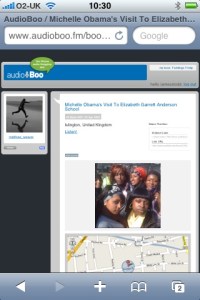
Essentially, the application lets you record audio on your iphone. You can’t edit it – but you can pause, then resume. Once you’re finished, you can upload it. However, you can also add information – maybe a picture of who you are recording or where you are. Since it’s recorded on the iphone, it also adds a GPS tag of where it is recorded. You can also tag the recording with keywords. Then, when you are finished, you hit publish, and it goes straight up to the audio boo website front page for anyone to hear. It’s simple and at present, you can’t make the recording private. You can publish anonymously – or linked to a user account (where you can manage /delete your audio). At first I couldn’t really see the point; there are loads and loads of posts, mostly strange or dull, or even just bizarre (like my test recording last night of the sounds you hear walking from Charing Cross to Embankment tube…)
embankment

[Audio http://blog.jamesstodd.com/page5/assets/Audioboo_walk.mp3%5D

So what does this mean for radio? Well, it depends on what you want from it to be honest. The quality is fairly good for a phone based recorder – but the ability to get audio online or even back to base quickly may outweigh any slight quality concerns. The example post above (from journalist Matthew Weaver) is one of his recordings from The Guardian’s blog coverage of the G20 summit.  He didn’t use everything he recorded – but then again, you wouldn’t use everything you recorded as a journalist.

[Audio http://blog.jamesstodd.com/page5/assets/Audioboo_obama.mp3%5D

Of course, The Guardian isn’t a radio station – but as mentioned before in my Twitter feed, they have 8 radio studios onsite – so the multimedia offering is increasingly important to them. In this case, they could have someone on the ground, recording audio and blogging, and then have it all tidied up on site.

For a radio station – particularly one on a tight budget, this is a method of allowing a journalist to be on site, to record an item in pretty good quality, and then to post the audio with nothing more than the click of a button. Now of course, at the moment, this audio is available for anyone to hear – so maybe each recording needs to start with “I’m XXXX for Badger FM onsite at xxxx before getting into the audio – thus tagging the audio with your station name. However, once it’s uploaded, it just needs someone back at base to find it, download it and if necessary delete it. Since you can also take a photo to upload with the audio, and later download it – you also have a way of not only getting audio content for a news bulletin up to the site, but also a picture of the event for the website. All the audio can be downloaded – either directly from the site into itunes, or by grabbing it via the RSS feed.

And of course, since your listeners have phones, the ability to make use of the resource of citizen journalists at a big event or news story is immensely useful.  Think about what you could get from listeners at a big music festival – or caught up in big travel chaos when the snow comes agin – or maybe on the day when school exam results come out. Get them to record audio and post it – you never know what great content you may get from it. Since the site lets you publish your updates directly to your Twitter account, I guess there’s a fairly easy way to tag these Tweets and aggregate them into one place. I’m sure there are people out there who could explain this aspect far more concisely than me…:-)

So, if you have an iphone, grab the application and give it a go. record something meaningful, or something bizarre. You never know who’ll be listening.


UPDATE:

Here’s how Richard Bacon is using it to interact with his listeners on 5 Live