New notes at BBC Radio 2

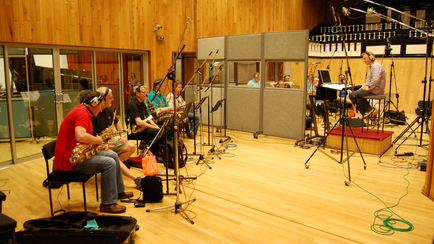
Photo (C) Wise Buddah

There’s been a refresh to the sound on air at BBC Radio 2 again. It’s an expansion to the package introduced on air last year.

The reason is due to how the original heritage logo had to be licensed from the original composers – Groove Addicts in the US. This time, there’s a newly composed musical logo from the guys at Wise Buddah. It’s all to do with the ways the publishing deal is done…

You’ll find full details about the changes on the Earshot website

But, here’s  a nice video that the guys at Wise Buddah have produced with a bit of behind the scenes session action.

Mashing it Up – XFactor Style

x-factor1

A nice video landed in my Facebook inbox this evening via my friend Kirsty Mullan who is the Entertainment marketing manager at ITV. It’s for the new series of the X-factor.

They’ve used a technique much popular in radio by the likes of David Konsky at 2DayFM and also by DJ Earworm. Instead of simply taking the biggest hits around, they’ve taken clips from some of the 33 number ones songs that the XFactor has produced over the years. It’ll be used on TV (and  I’m guessing on radio adverts too) in the coming weeks.

To celebrate a decade of the X Factor ITV have created the Ultimate X Factor Mash Up. Using a selection of hits from artists discovered on the show over the years to create an infectious medley.

See what you thing of the result. Oscar Carriss, head of creative at ITV and remixer / DJ Robin Skouteris are the guys responsible – and I’m guessing it’ll be a big hit too.

Bass. How low can you go?

Image  wwwfunkydowntown.com)

The guys at the Benztownbranding Blog posted a great tip this week about the amount of bass you have in your final mix if you’re an audio producer. Now many of you may not be hands-on audio guys, so maybe skip this post. But for those who are – their blog raised a couple of interesting points. You can read it in full here.

One thing that is definitely key is the amount of bass you have in your final mix. Every piece you add in to a promo or imaging piece will have differing amounts of bass frequency. The more you add, the more is added to your final mix. And of course, the more that happens, the louder it gets and the harder to hear the overall piece clearly.

The key to any piece is using the frequencies to find places for all your elements. Something I was taught by a great producer, Linc Kelly, was how you can easily scoop out a place for your Voiceovers by cleverly scooping out a certain frequency in music to let the VoiceOver cut through more cleanly. Equally, when you come down to the master channel, or maybe the aux that you route each VO into, you need to to ensure that you roll off some of the bass at the lower end (in the frequencies that most normal radio listeners won’t hear). If you find your VO has too little bass, there are plug in such as Waves MaxxBass which add “pseudo bass” without adding much bass to the resulting sound.

One other basic tip (a bit Production 1.01 but relevant nonetheless) is to ensure you are monitoring your final mix through smaller speakers than your huge studio monitors. Either have a smaller pair of monitor speakers that emulate a domestic hifqi, or even , plug in a pair of headphones and listen through them whilst they are lying on your desk turned up – they’ll emulate a small bedside radio. When I first started producing, I’d listen via the monitor speaker on an old Studer Reel to Reel machine – but doubt any studio or radio station even has one of those lying around these days!

I’m no engineer – I’ve picked up my skills through years of doing and reading – but if you’re new to the game, you’ll find loads more tips on the Benztown Branding blog and others beside. Do take a look around – you never know what you might find..


The new look and sound to ITV

itv-unveils-new-brand-identity-look

It’s always a big day in a radio station’s live when the new station sound arrives on air. Mostly for the on air and production team. For the listeners, it’s often a big change as the audio furniture, around something that many simply listen to, has changed. Sometimes it’s a huge change. More often than not its a more subtle one.

When a TV station changes it’s branding, the look is often more radical. Think of when BBC One changed from the balloons to the current suite of circular idents. A big change of look and sound. The same will happen soon across all BBC channels – and it’s interesting to see how important the sound of the idents is compared with the look. Often, it feels like its more of an afterthought.

Today, the ITV network has changed the way it looks and sound on air.

Take a look

What I particularly like is that there is a pretty distinctive audio identity on most of these idents. It’s a three note theme that blends within the music. Whilst an esoteric blend of audio themes does complement a visual identity, such as that of Channel Four, for me, a more distinctive sound that adapts and matches with the visual look always helps to enhance the overall branding.

You can find out more background on the ITV rebrand at the iMediamonkey blog

Do it differently

photo

When I say creative people – I’m not just thinking about people paid to be creative in their job titles. Obviously, anyone in any job has the ability to be creative. Not everyone is encouraged to be captive. But creativity can come in all sorts of different ways. From creative ways to solving problems to creative ways of designing a product.

As I head back into my new job – though 3 months in, it feels far from new – I’m really conscious that its more than tempting to slip into do everything the same way all the time. As work piles on and deadlines loom, the pressure to get things delivered by an all too short deadline mount up. But there are always opportunities to approach things differently. I was pleased to see that whilst I’ve been away – someone who doesn’t get involved in the creative writing process had tackled a brief for a local client. It would have been easy, and tempting, to write something pretty functional to deliver the brief. But faced with a challenge, she has written something far more fun that does the job in a more entertaining way. It may need a little polishing to make it work entirely how I’d want it to work, but the fact that she’s approached it a different way is really refreshing.

So what will you try to do differently today?

Testing the transmitter

Image by www.photoeverywhere.co.uk

There have been many ways used to create “test transmissions” on UK radio stations – the output broadcast on a service before it officially launches.

Some played montages of music.

Some play the output of other radio stations.

Some played Birdsong.

Jack FM in Oxford are doing it a little differently as they prepare for the launch of the new Oxford DAB Multiplex – by broadcasting a short history of Oxford. It’s running in simulcast on all 5 Oxfordshire DAB channels as the test signal and the multiplex launches  Friday 21/12/2012

It’s easy to the same as everyone else – this is a great way of creating a local buzz and maybe boosting local pride a bit too..

Take a listen..


The Truth about Creative sessions

Wallace and Grommit run a voice session - Photo - James Stodd
Wallace and Grommit run a voice session – Photo – James Stodd


A quick post triggered by Dan McGrath at This is Bounce for anyone who has ever had to run an audio session where an advertising agency (“the creatives”) or a client (“the pains in the backside who often change their mind for no reason but ultimately hold the budget”) are in attendance.

I’ve certainly had sessions like this (though thankfully not for a very long time – but the situations are all too familiar.

If you’re in the middle of your pre-Christmas client nightmare, take a moment or two to give it a watch!

And should you need any audio or music for projects, take a look at This is Bounce – they make a nice cup of tea and often have nice biscuits in too..

[youtube http://www.youtube.com/watch?v=oVPkm5zE6QI]

The Sweet Sound of Student Success

IMG_3978

Another year, another Student Radio awards.

As I write this, I’m guessing most of the students are still on the dance floor of the IndigO2 enjoying the sound clash from Greg James, James Barr and others.

It’s hard to know where to start really. This was another fantastic night that celebrates all that is good about Student Radio. It’s a far cry from when I did student radio, but it would be wrong if things hadn’t moved on.

This was a room full of enthusiasm and excitement – and frankly a radio awards show that both the Sonys and possibly Arqivas could learn from. It was hosted by Radio 1 breakfast host Nick Grimshaw and Capital FM Breakfast host Dave Berry. They made a fantastic pairing and gave the whole event a real sense of fun. And it was great to see Global Radio fully involved with the awards again. Whilst its easy to sneer at Global as the bad guys of UK radio, they should be a company that people aspire to work for; they have some fantastic brands and they really know how to market them. Their video that played during the event showed a slick operation – and it’s those sort of values that they translate on air too.

Last year I wrote that the most important thing about student radio is that it allows you to fail. And you need to fail and be given the room to fail in order to succeed. Good bosses and producers know that they need to let their “talent” do this in order to succeed. Whilst its hard to always get the opportunity to do this on commercial radio, it’s important to remember that creativity comes in all aspects of a job. And just because the format of the station you end up working at requires quick links, you need to be able to think of new ways to be entertaining in those short spaces.

It was nice to see this thought repeated in a blog by a recent Student Radio graduate, Robin Murphy.

It was somewhat appropriate then that he picked up 2 awards tonight for his station URN. They won more, but I’m particularly interested in one – that for Best Marketing and Station Sound.

You can hear an example of what their entry sounded like here:

I hope that Robin and the team at URN will come and describe what made their marketing entry award winning on a future Earshot Creative Review Podcast – and hopefully some of the other finalists will be able to contribute too. The guys backstage caught up with Robin to find out his reaction on winning

When I was on the tube home from the awards, I was chatting to a student from Bristol Uni. She said “you won’t have heard of our station. We’re pretty small and don’t have huge funding – but we’re getting better”. She was really fired up after the awards – and that’s really what they are all about isn’t it? And it’s worth remembering that not everyone is a URN or Fly FM – there are loads of smaller stations that are just as enthusiastic and striving to produce output as good or better than these stations.

So, if you won, you impressed a lot of important people. If you just missed out – it was probably by the slimmest of margins. And if you didn’t win again – go back and think what you can do differently this year. It’s not necessarily the awards that count. It’s what you learn whilst trying to win them that counts.

Would Kenny Everett be allowed to flourish in radio now?

kenny_everett

Last week, I watched a wonderful drama about the life of the radio producer and broadcaster Kenny Everett.

For those of you born in the late 80s, or who aren’t from the UK, Kenny Everett was an amazingly creative radio broadcaster with an almost bottomless imagination. I never heard his shows on the radio. In fact, I never really watched his TV shows since my Mum thought he was a little vulgar.

He was an amazingly creative broadcaster who created a sonic world out of his imagination. All without digital editors, keyboards, and computer plugins – but a highly creative brain and some pretty deft production tools – using tape and multitrack recorders and pretty much any sound effect creating device he could find. And of course, a cast of thousands from one man’s voice.

There are numerous sites dedicated to him – this one seems a good starting place.

He made jingles for his shows. He wrote and produced promos. And he did it all himself.

And he broke all the rules. In fact, he was sacked many times for breaking those rules.

But how would radio in 2012 have reacted to this broadcaster? Would they have let him flourish or would they have trimmed his wings so that his creative expression was tamed? It’s interesting that the station that hired him after his sacking from the BBC was Capital Radio. Back then, when Capital started, it was a station that had everything to win. It took risks, had a range of shows from rock to classical, and it was huge. Here was a broadcaster that was also larger than life and took loads of creative risks.

What would Kenny have made with the laborious compliance process? Would it have curtailed his creative journey – or would the rules and regulations actually have helped him to refine his comedy?

One thing is clear – there is a real need for someone like Kenny in radio these days. Maybe someone to work in your creative or imaging department or maybe someone on air. Without people like Kenny, radio is slightly less interesting. If you have never heard any of his shows or production, you should take a listen – you might learn something.